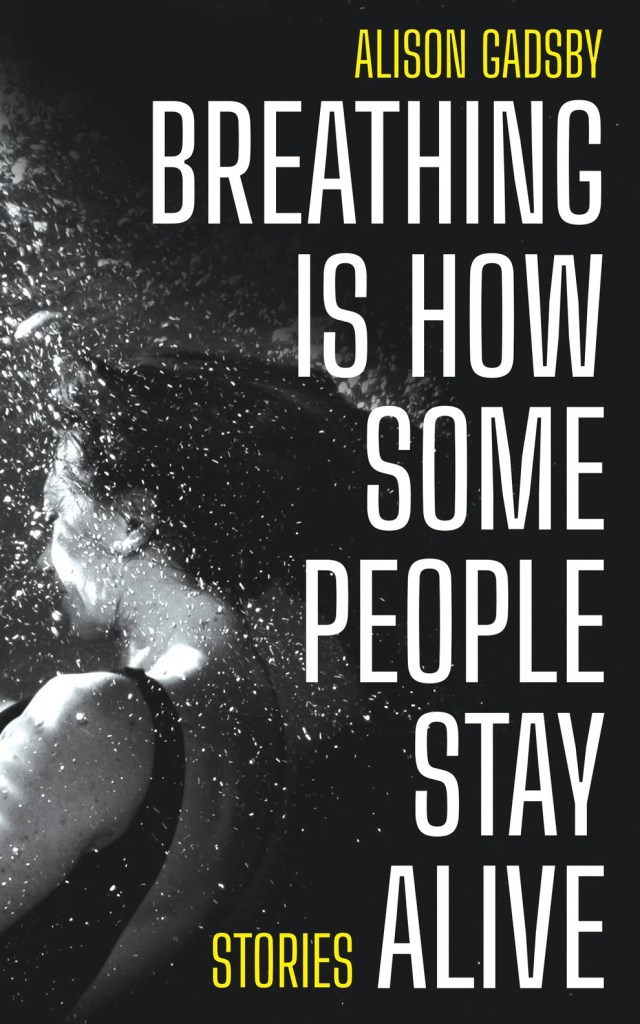
I was fortunate to read “Breathing is How Some People Stay Alive”, a collection of deeply visceral short stories by Canadian writer, Alison Gadsby. Futuristic and catastrophic, her writing is inexplicable and draws the reader through the unfamiliar to bear witness to the subtle acts of violence and their memory enacted upon women’s bodies, regardless of time or space.
The wicked and plain madness of robots and pregnancy
The collection begins with “The Deal with Roger”, an absorbing and disquieting exploration of a woman’s loneliness and her desperate climb out of a codependent and sometimes violent relationship. Gadsby subtly builds tension and a familiar world around Mirabel, she goes for weekly swims and has an overbearing father but there is something slightly off. The world advances and stays the same.
Alison Gadsby truly excels at inviting us into the inner lives of women, not at their best or most achieved, but when their sexuality turns them to brutes and their apathy is intent on destroying all that is good around them. Anger and retributive violence are made available to women’s curiosity in “Breathing is How Some People Stay Alive”.
“Swimming” is a story about the wicked and plain boring madness of early motherhood when time is lost and the ends of your body are connected to an infant or aching for it. Gadsby expertly weaves in the casual misogyny of the narrator’s father-in-law, her body and mind pulled in multiple directions by the men and boys that surround her. The outcome makes as much sense as it does not. It is like looking at something you think you know, but it has fallen into the water and the waves obscure its lines.
The acts of violence are startling and ethereal, like in “The Going Rate of Grief”, where time is a manipulation if you try hard enough. The futuristic setting she has created, brick by innocuous brick is its own form of violent oppression and judgment. Each story is a weird, intricately woven experience in the unexpected.

Who should read “Breathing is How Some People Stay Alive”
Alison Gadsby’s “Breathing is How Some People Stay Alive” is for every woman and female aligned or assigned person who has stood at the edge of a precipice and imagined who they would push into it. It is for the readers who spread fire across the shiny surface of a conference room table when the men won’t let anyone else speak, for fear of being caught in their lies. It is for anyone who likes the weird and wonderful and imagines what it would be like to poke a jellyfish with their brother’s finger.
There is realistic reference to sex and violence as well as the indignities and injustices of being alive: Cancer, infertility, alcohol and abuse. Dreams lost and found. Loneliness and the ecstatic experience of love. That is the gift of Gadsby’s writing in this collection. It is set in an automated future society with the same petty realities and fears of human experience.
“Breathing is How Some People Stay Alive” is available for pre-order now, full publication by Guernica Editions in March 2026. To see more from Alison Gadsby, check out her website and follow her on IG!
Special thanks to Guernica Editions for making the collection available to read on NetGalley!